The Beauty of Scars
Can anything beautiful come out of brokenness? Does being shattered have to mean the end of hope, or can our fragments be repurposed, offering a chance of new life?
In spring 2022 I held in my hands the jagged fragments of a Japanese bowl I’d rescued decades earlier when a shelf of dishes unexpectedly crashed. I had picked up all the pieces and, in tears, packed them in a box. Those broken pieces traveled with me and my family through six moves to four different states.
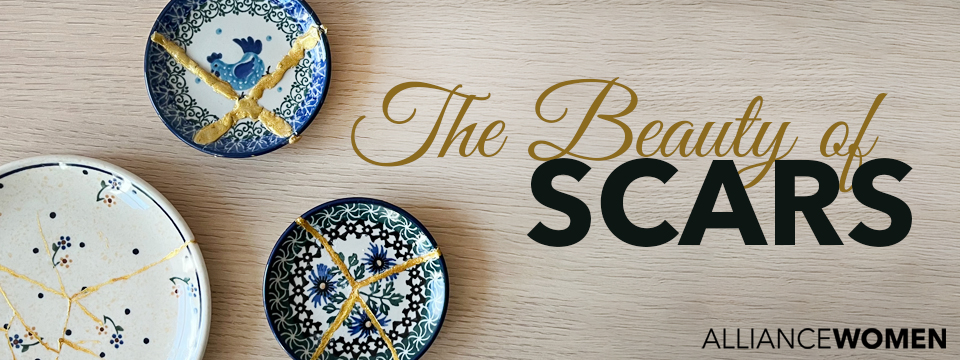
Now, I joined others around a table as we contemplated our broken heirlooms. Together, in their restoration, we would learn not to hide the scars but highlight the beauty from the scars.
Japan was my birthplace, which led to a lifelong love for the people and culture. So, when I heard about a kintsugi experience workshop, I decided to attend and heard our facilitator describe this 400-year-old Japanese art form. Kin means gold and tsugi means repair. Kintsugi involves the mending of broken pottery or ceramics using gold. Seeing a bowl mended with kintsugi is a tangible reminder of how God takes our brokenness and makes us beautiful in His time.
Processing the brokenness
All of us around the table took the time to slow down and to reflect, to consider the rough edges of our broken pottery and broken experiences. My thoughts centered on some painful transitions that had shaped my life over the years.
My most significant transition had occurred more than 25 years earlier, when my family and I returned from the mission field after having spent only 40 days and nights in Nepal. Our visas never arrived to serve in India, so after the summer of waiting, the door closed, and our dreams and hearts were broken. Shortly after, we moved from California to Colorado, where we had to redefine ourselves and find our feet again. No longer commissioned, no longer known — we also felt no longer seen.
After three and a half years in Colorado, we again prepared to be uprooted — this time to Nebraska, for church planting. That’s when the dishes crashed to the floor. The flood of grief that followed seemed to combine all of my loss, shattered dreams, and unmet expectations. Yet amid my tears, God laid on my heart that it was time to move on, and I needed to resist the urge to stay comfortable. He had provided in the past; surely, He would provide again.
Hope formed
The shattered pieces before me represented all the moves, shifting relationships, fresh goodbyes, and disappointments. As I held my pieces, I thought about how God holds us in our grief spaces as He orchestrates our healing. I also better understood the vulnerability it takes to allow the holding. Then my mind shifted toward hope — hope in what God can do with the shattered if we lean into His purposes. “Not only that, but we rejoice in our sufferings, knowing that suffering produces endurance, and endurance produces character, and character produces hope” (Romans 5:3-4, ESV).
Facilitating and naming
This hope in God alone became the catalyst that drove me to pursue training to facilitate kintsugi experiences. I now set the table for others to process their brokenness and help them take a step toward wholeness, understanding, and hope.
A significant part of a kintsugi experience involves naming. The mended piece represents God’s transforming work in each participant, so people select names for their pieces. I chose Courage for a piece I worked on. I saw before me the reminder of what God wants in our lives: to choose the hard road of reconciliation, even when the timing is not always in our control.
Mending in community
The value of mending in community has been profound. Sharing our named pieces creates pathways for connection and shared experiences. In the workshops I facilitate, ministry happens across the table as stories unfolded, and each participant feels seen and heard.
Gold applied
The final stage in the modern kintsugi experience involves applying the gold. Breaks in our ceramics become mended scars. Painting the gold highlights the broken as a reflection of God’s redemption — how He takes what’s hard and shines His glory through it.
I’m filled with awe as I watch God use art to work in the hearts of those around the table. The table is set but the work becomes His work. The opportunity to slow down, to share together, to make new, and to form hope is a beautiful and sacred space. Beauty is formed from brokenness.